Andrea Silverman
Multimodal AI Evaluation Systems
Frameworks for measuring identity consistency, motion realism, prompt fidelity, and temporal coherence in generative image and video models
Evaluation Framework | Core Evaluation | Model Analysis | Examples | Failure Mode
Overview
Generative video systems often produce visually compelling outputs that degrade across time due to identity drift, motion artifacts, or prompt misalignment.
This work focuses on defining structured evaluation criteria that make model behavior measurable and improvable across runs.
Evaluation Framework
The framework separates generative video quality into independently measurable dimensions, allowing targeted improvements without overfitting to a single aesthetic outcome.
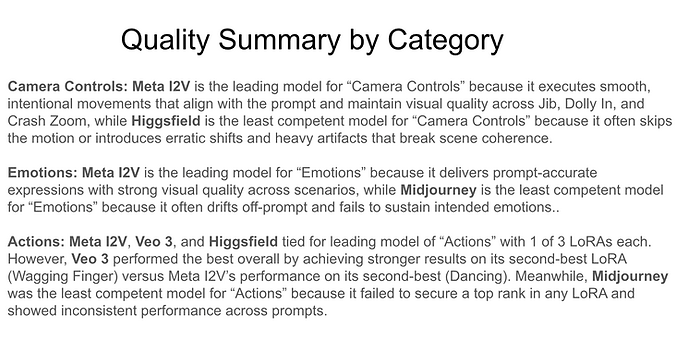
Core Evaluation Dimensions
Identity Consistency
facial structure continuity
hair style persistence
wardrobe stability
skin tone continuity
Motion Realism
natural limb articulation
consistent motion speed
absence of temporal artifacts
Prompt Alignment
accurate interpretation of actions
emotional alignment with script intent
camera movement fidelity
Visual Coherence
lighting consistency
texture stability
environment continuity
Comparative Model Analysis
Structured comparisons reveal consistent strengths and weaknesses across models.

Evaluation Methodology Examples
Selected artifacts demonstrating structured evaluation of generative video systems across identity stability, motion coherence, prompt alignment, and audiovisual synchronization.
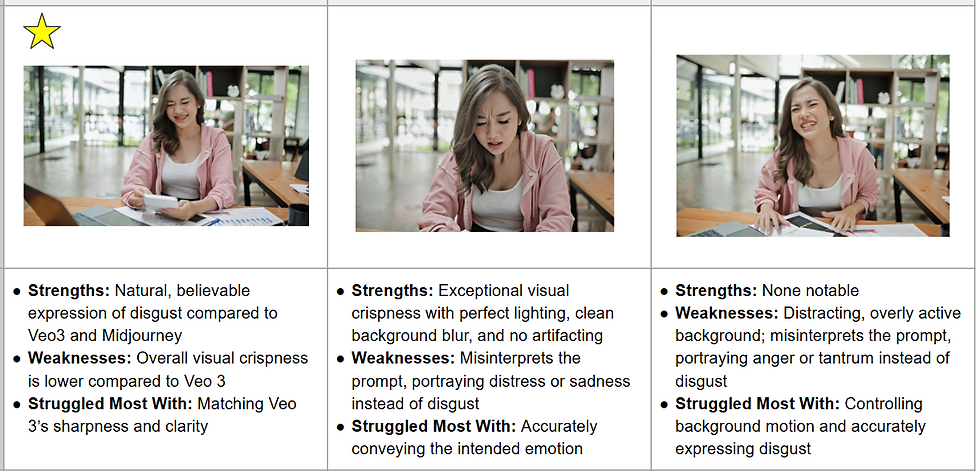
structured comparison of model emotion performance

structured comparison of model motion performance

structured comparison of model motion performance
Failure Mode Identification
Structured comparisons reveal consistent strengths and weaknesses across models.
Common failure modes include:
identity drift across frames
wardrobe or hairstyle instability
inconsistent lighting adaptation
emotional discontinuity
motion pacing artifacts
Example:
Character appearance changes unexpectedly due to underspecified identity anchors in prompt structure.
Insight:
Identity stability improves when prompts include persistent character attributes across shots.
Style-Dependent Identity Behavior
Certain visual styles inherently introduce identity preservation challenges.
Highly stylized rendering pipelines may reinterpret facial structure, texture continuity, or material consistency.
Evaluation criteria should adapt tolerance thresholds depending on visual abstraction level.
Example:
Claymation style introduces texture reinterpretation that may not indicate prompt failure.
Insight:
evaluation systems must distinguish stylistic transformation from identity loss.
Application to Generative Video Systems
These evaluation frameworks support iterative improvement loops in AI-generated media pipelines.
Outputs from evaluation layers inform:
prompt structure adjustments
persona constraint refinement
character definition clarity
timing optimization
This enables more reliable generation of dialogue-driven character videos.
Relationship to Persona Architecture
These evaluation frameworks support iterative improvement loops in AI-generated media pipelines.
Example Use Cases
These evaluation frameworks support iterative improvement loops in AI-generated media pipelines.
Outputs from evaluation layers inform:
AI-generated dialogue videos
character-driven recommendation content
synthetic spokesperson systems
multimodal conversational interfaces
Visual Consistency Controls for Multimodal Training Data
White Balance Normalization
BEFORE | AFTER
Skin Tone Fidelity
BEFORE | AFTER
Exposure Normalization
BEFORE | AFTER
Cinematic Color Grading
BEFORE | AFTER
Style Consistency Across Images
BEFORE | AFTER


Example transformations used to expand dataset diversity while preserving identity consistency and lighting coherence:
• illumination normalization
• tonal curve alignment
• color cast correction
• contrast harmonization

